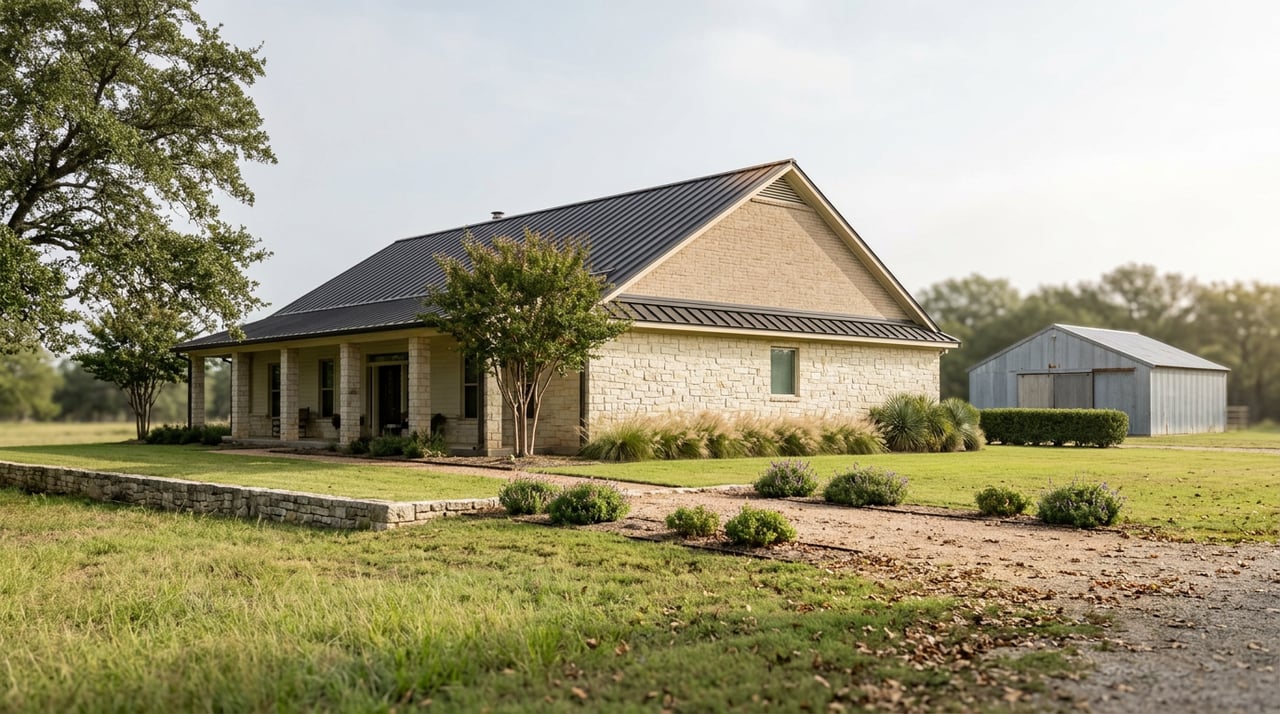
What Happens To The Ag Exemption When A Helotes Ranch Changes Hands
September 17, 2026
September 17, 2026
The listing sheet says the taxes on this 22-acre property near Helotes run a few hundred dollars a year. That number looks like a fact about the land, the same way square footage or lot dimensions are facts about the land. It isn't. It's a status, granted by Bexar Central Appraisal District based on how the current owner uses the property, and it does not automatically follow the deed to closing.
That distinction matters more here than in most suburbs Frontline Properties covers, because Helotes acreage sits in a part of Bexar County where two separate systems, the ag valuation and the septic permit, both hinge on facts that change the moment a new owner shows up with different plans. Buyers who treat either one as a fixed feature of the house can find themselves owing a tax bill or a maintenance contract nobody mentioned during the walkthrough.
Texas calls it an "ag exemption," but the term is misleading. Under the state's 1-d-1 open-space provision, qualifying land is appraised on what it produces agriculturally rather than what it would sell for on the open market. Nothing is technically exempted. The taxable value is just calculated a different way, and that difference tends to be large.
Bexar Central Appraisal District's own worked example shows the gap: a twenty-acre tract taxed on productivity value paid roughly $1.40 per acre, while the same tract at market value would have paid around $26.25 per acre. That's the entire appeal of buying land with an existing ag valuation. It's also the trap. The valuation belongs to the land's use, not to the person selling it, which means a buyer has to file their own application, typically Form 1-D-1, with Bexar Central Appraisal District, usually by April 30 of the year following the purchase. Miss that window and the low bill simply does not renew. Nobody at the closing table is required to remind you.
Here's the part that surprises out-of-state buyers most: closing on ag-valued land does not, by itself, cost anything extra. The trigger is a change in use. Fencing off two acres for a yard, letting the previous owner's cattle lease lapse without replacing it, or breaking ground on a homesite where hay used to grow are all changes that can end the qualifying use on that portion of the property. When that happens, the county recaptures the difference between what was paid and what would have been owed at market value, plus interest, for a lookback period set by state law. That lookback period has changed over the years through legislation, so a worksheet a seller hands you from an old transaction may not reflect the current figure. Confirming the exact number directly with Bexar Central Appraisal District before you close is worth the phone call.
Bexar County also sets its own acreage thresholds by activity type, and they are not interchangeable:
| Qualifying activity | Typical Bexar County acreage threshold |
|---|---|
| Livestock grazing operation | 7.5 acres devoted to the operation |
| Hay meadow | 10 or more acres |
| Row or broadcast cropland | 20 or more acres |
| Smaller tracts (6 to 10 acres) | May qualify only if leased into an adjoining operation |
| Wildlife management conversion | Requires 5 of the previous 7 years already under ag valuation |
A buyer who assumes any acreage automatically qualifies, or who plans to keep the valuation with a couple of goats on six acres, may find the intensity standard doesn't match what the county actually requires.
Helotes sits inside the mapped Edwards Aquifer Recharge Zone, the same regulatory boundary the Edwards Aquifer Authority tracks quadrangle by quadrangle, with Helotes named explicitly on its own zone map. That designation isn't cosmetic. Texas septic regulation under 30 TAC Chapter 285 pushes properties in environmentally sensitive areas, the recharge zone specifically named among them, toward aerobic treatment systems instead of the simpler, cheaper conventional septic tank and drain field. Aerobic systems come with a mandatory maintenance contract, inspections roughly every four months, and a licensed provider relationship a buyer can't skip once they own the property.
Bexar County adds one more local wrinkle on top of the state minimum: even conventional systems, which have no formal state reporting requirement, need a renewal filed with proof of tank pumping every five years, for a $30 fee.
None of this is theoretical for the area right now. In October 2025, the Texas Commission on Environmental Quality approved a permit allowing the planned Guajolote Ranch subdivision to discharge up to a million gallons of treated wastewater into the headwaters of Helotes Creek. Residents of nearby Grey Forest and the Greater Edwards Aquifer Alliance opposed the permit and have pursued an appeal. State Representative Mark Dorazio spoke at the TCEQ hearing to underscore the stakes.
"The Helotes Creek watershed represents 15 percent of the Edwards Aquifer Recharge Zone."
Whatever the appeal's outcome, the fight itself is the point for a buyer: water quality regulation in this exact stretch of Bexar County is contested and active, not settled background noise. Anyone evaluating a well or septic-dependent property near Helotes Creek, Scenic Loop Road, or the broader Grey Forest area is buying into a watershed where the rules are being argued over in real time.
Does selling the land trigger a rollback tax by itself? Under the common 1-d-1 open-space appraisal, no. The trigger is a change in use, which may happen at the same time as a sale or years later. Under the older 1-d appraisal, selling does trigger the rollback regardless of what the buyer intends to do with the land.
Can I keep the ag valuation without running my own cattle? Yes. Leasing the acreage to a neighbor's grazing operation is a common way absentee or new owners maintain a qualifying use while they decide what they want to build.
Is a septic inspection required before closing? Texas doesn't mandate one at sale, but FHA, VA, and USDA loans typically do, and given how often recharge zone properties run aerobic systems with active maintenance contracts, it's worth doing regardless of loan type.
Buying acreage near Helotes is still one of the more rewarding moves in the San Antonio suburbs, and Government Canyon State Natural Area, John T. Floore Country Store, and the Hill Country views that come with a place like Retablo Ranch or Helotes Ranch Acres are real reasons people choose it. The paperwork just asks for a closer read than a standard subdivision lot does.
If you're weighing a specific acreage property near Helotes and want someone who will walk the tax and septic questions through with you before you write an offer, not after, Monique Cardenas and the Frontline Properties team would be glad to help. Get a Free Home Valuation and let's talk through what your particular parcel actually requires.

Monique is here to guide you every step of the way. With care, clarity, and a focus on results, she’ll help make your next move easy and successful. Reach out today and let’s get started!

Frontline Properties
Office Address 23702 I-10 Ste. 105 San Antonio TX 78257 Brokerage Address 23702 Frontage Rd IH10 West Ste. 105 San Antonio TX 78257