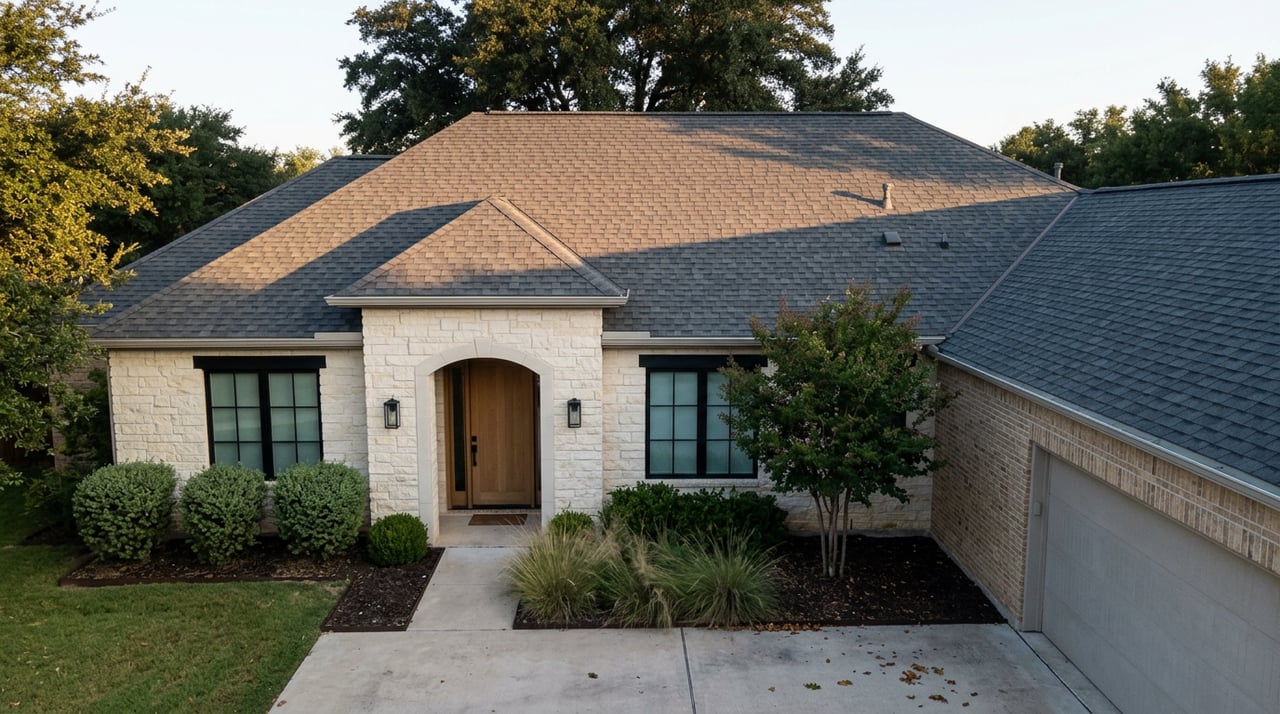
The Insurance Question Stone Oak Sellers Can No Longer Skip
September 10, 2026
September 10, 2026
If you're getting ready to list a home in Stone Oak this fall, there's a new line on the paperwork that didn't exist a year ago. It sits early in the Texas Seller's Disclosure Notice, and it asks something no version of the form has asked before: has this property ever had trouble getting insured. Not whether the roof leaks. Not whether the foundation has moved. Whether an insurance company has ever looked at this specific house and said no, or said yes only at a punishing rate.
For most Texas sellers that question is a formality. For sellers in the 78258 zip code, it is closer to a confession. Stone Oak sits in one of the more active hail corridors in the San Antonio metro, and a meaningful share of its housing stock is already carrying its second or third roof since it was built. The paperwork just caught up to a reality Stone Oak homeowners have been living with for years. It now shows up on page one of the disclosure, before a buyer ever walks the property.
The Texas Real Estate Commission adopted this update on May 4, 2026, acting on a directive from the Sunset Advisory Commission, and made it mandatory for contracts signed on or after July 1, 2026. That means every listing that has gone under contract this summer and fall has used the new Seller's Disclosure Notice, and every one still to come will use it too.
The commission didn't ask for cosmetic language. It directed TREC to tell buyers three specific things: whether the property is currently covered by insurance, whether that coverage includes windstorm protection, and whether the seller has ever been unable to insure the property for any reason. That third question is the one doing the work. It captures non-renewals, forced placements with the Texas FAIR Plan, and quiet coverage denials that never made it into a CLUE claim record.
A seller no longer decides whether a buyer learns about insurance trouble before the option period. The state made that decision for them, on the form, in writing.
More than 120,000 Texas homeowners were relying on the FAIR Plan, the state's insurer of last resort, as of mid-2026, and that number has been climbing. A property that's been pushed there, or even just declined by a standard carrier once, now has to say so in writing before a buyer signs anything.
Texas runs through what the insurance industry calls a hail corridor, a band that cuts from the Dallas-Fort Worth metroplex down through Central Texas and includes north-central San Antonio. Stone Oak sits inside it. The neighborhood produces a qualifying hail event roughly every two to four years on average, which is why it's common to find homes here on a second or even third roof within fifteen years of construction.
San Antonio's most cited example is still the April 2016 storm, which caused an estimated $1.4 billion in insured losses across the metro and touched a wide swath of the northwest side. Storms of that scale aren't an annual event, but smaller qualifying hail has kept showing up often enough that insurers now treat roof age in this corridor differently than they do almost anywhere else in the state.
That treatment tends to follow a pattern:
| Roof Age | Typical Insurer Treatment in 2026 |
|---|---|
| Under 10 years | Full replacement cost coverage widely available |
| 10 to 15 years | Coverage still available, but some carriers begin asking for inspection or documentation |
| 15 to 20 years | Many carriers convert the roof to actual cash value only, or add a cosmetic damage exclusion |
| Over 20 years | New policies become hard to write; FAIR Plan is increasingly the only option |
A house doesn't have to be storm-damaged to fall into that second or third row. It just has to have the wrong birthday on its roof.
The first is the CLUE database, which tracks a property's insurance claim history for roughly the past seven years. A buyer's insurer pulls this report as a matter of course. If a seller answers the new disclosure question in a way that doesn't match what CLUE already shows, the mismatch itself becomes the problem, not the original claim.
The second is the declarations page most sellers have never actually read line by line. Many Texas policies now carry an actual cash value schedule that kicks in once a roof crosses fifteen years, along with a cosmetic damage exclusion endorsement that limits payouts to damage that actually leaks. Texas law limits how much a single weather-related claim can be held against a policyholder, so one hailstorm on its own rarely triggers a non-renewal. But a roof that's already on ACV, or already carrying a cosmetic exclusion, tells a buyer's insurer something the seller may not have known to say out loud: this roof is priced like it's near the end of its useful life, whether or not it's ever failed.
The third is specific to Stone Oak's layered HOA structure. Several of the neighborhood's associations keep an approved list of roofing materials, and a seller who reroofs before listing without checking that list first can create a second disclosure problem on top of the first, an unapproved exterior modification that has to be resolved before closing rather than after it.
Pull your own CLUE report before a buyer's insurer pulls it for you. It costs nothing to know what it says in advance, and it lets you answer the new disclosure question with confidence instead of guessing.
Find your roof's actual install date. If a previous owner replaced it, the invoice or permit record is what resets the clock with an insurer, not your own memory of when you bought the house. Without that paperwork, a carrier will default to the age of the house itself.
Read your own declarations page before a buyer's lender asks you about it. Look specifically for actual cash value language and any cosmetic exclusion endorsement. If either is already attached to your policy, that's useful information to have ready rather than a surprise mid-option-period.
Check your HOA's approved roofing material list before you schedule any pre-listing repair or replacement. A quick call to your association saves a second round of paperwork later.
If you do replace the roof before listing, ask your roofer about Class 4 impact-resistant shingles and keep the documentation. Beyond the insurance discount many carriers offer for it, it's the kind of clean paper trail that answers a buyer's insurance question before they think to ask it.
Does one hail claim get a seller dropped or non-renewed? Not by itself. Texas law limits how insurers can use a single weather-related claim against a policyholder, so one hailstorm rarely triggers a non-renewal on its own. What changes outcomes is roof age and repeated claims, not one storm.
The hail damage was repaired years ago. Does it still need to be mentioned? Yes. The disclosure standard is what the seller knows, not what's still visibly broken. A repaired claim is still a claim, and it's still in CLUE.
My roof is newer than most of my neighbors'. Does the corridor status still matter to buyers? It matters less for your specific roof, but a buyer's insurer still prices your zip code alongside your house. A newer roof with clean documentation is the strongest answer to that concern, and it's worth having that paperwork ready to hand over.
Selling in a hail corridor doesn't mean starting from a disadvantage. It means the paperwork now rewards sellers who get ahead of it instead of discovering it during someone else's inspection contingency. That's exactly the kind of groundwork Frontline Properties walks Stone Oak sellers through before a home ever hits the market, from pulling the right reports to coordinating any repair work an HOA or insurer will want documented. If you're weighing a listing this fall, reach out for a free home valuation and a straight answer on where your specific roof and policy actually stand.

Monique is here to guide you every step of the way. With care, clarity, and a focus on results, she’ll help make your next move easy and successful. Reach out today and let’s get started!

Frontline Properties
Office Address 23702 I-10 Ste. 105 San Antonio TX 78257 Brokerage Address 23702 Frontage Rd IH10 West Ste. 105 San Antonio TX 78257